
In January, I wrote a post on 7 business models for linked data (with an 8th model added shortly thereafter). Although far from comprehensive, it attempted to illustrate the range of direct revenue vs. indirect revenue models that could justify development of linked data initiatives.
A number of people from the linked data community contributed feedback and suggestions of additional models, including Leigh Dodds (Thoughts on Linked Data Business Models), Paul Groth (Another 5 Linked Data Business Models), Eric Hellman (8 One-Way Business Models for Linked Data), and John S. Erickson (The Evolution of Linked Data Business Models).
However, some of the best feedback came offline from Rachel Lovinger at Razorfish (and author of the blog Meaningful Data). Over a series of discussions, we developed an expanded model:
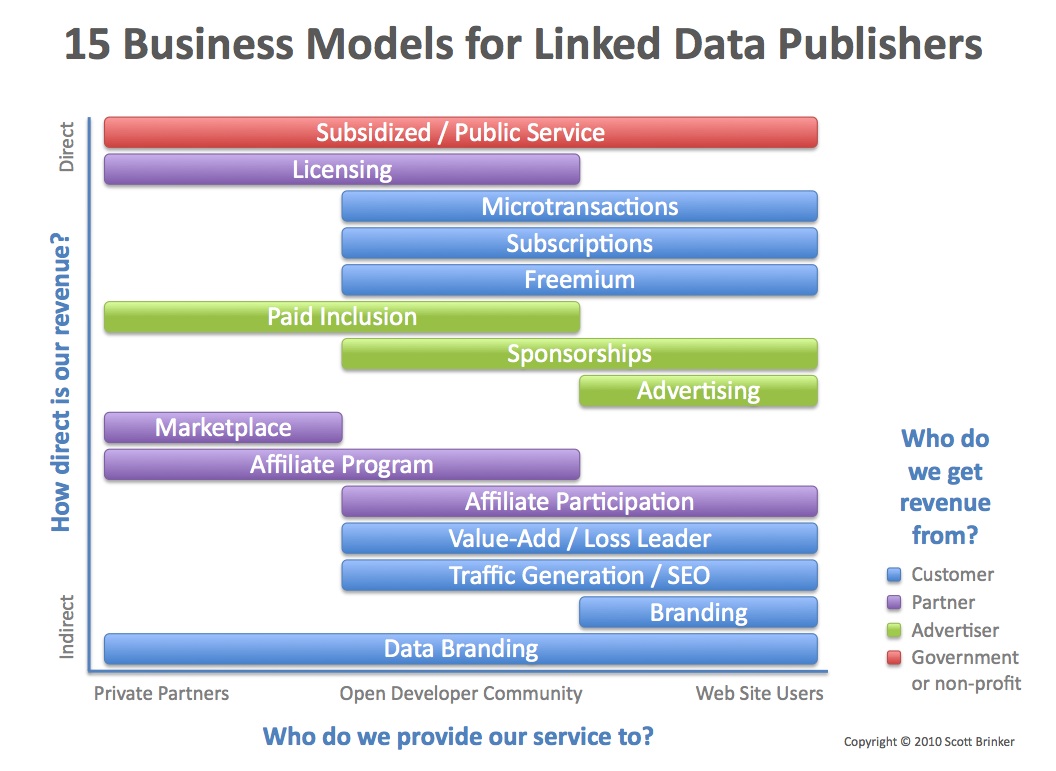
There are three dimensions in this model, which we phrased as questions:
1. How direct is our revenue? This is the Y axis of the chart. At the top are ways of directly being paid for data, such as licensing and subscriptions. Toward the bottom are more indirect revenue sources, such as using data to drive traffic to a web site or build one’s brand and reputation.
2. Who do we provide our service to? Along the X axis are three categories that identify, from left to right, the openness and accessibility of the service.
On the far left are private partner relationships, where data is provided in closed relationships with partners who use it internally or incorporate it into other offerings downstream. In the middle, data is provided via APIs to a more open developer community, who in turn leverage the data in more public facing applications. And on the far right are web sites that regular users visit or subscribe to, without requiring any technical expertise on their part.
3. Who do we get revenue from? For any given model, the direct user of the service and the source of revenue are not necessarily the same. For instance, with a subscription model the users and the revenue source are the same; with an advertising model, they’re usually two different constituencies.
We used colors to distinguish four classes of revenue sources: blue from direct customers, purple from partner relationships, green from advertisers, and red from “subsidized” sources such as government or non-profit mandates.
In this landscape, we identified 15 business models that offer a good representation of the different ways in which organizations can monetize — directly or indirectly — data publishing initiatives:
- Subsidized/public service: funded by a government, an NGO, or a regulatory mandate — revenue = funding.
- Licensing: charge fees to let developers use data in other environments.
- Microtransactions: on-demand payments for individual queries or data sets.
- Subscriptions: charge for access to data for a period of time (may have tiers for different levels of access).
- Freemium: free but limited access to data to sample, but charge for extended premium access.
- Paid inclusion: charge to be included in the data set or attributed valuable meta-data (what I formerly called an “authority” business model).
- Sponsorships: charge a small number of advertisers for brand visibility of sponsoring the data.
- Advertising: charge for ads placed around data on web pages (may also tap into ad networks).
- Marketplace: provide data to a partner service in exchange for an opportunistic royalty.
- Affiliate program: provide data streams to affiliates who distribute them in other applications in exchange for commissions on related sales.
- Affiliate participation: as an affiliate of other companies, combine affiliate product links with data to earn commissions on related sales.
- Value-add/loss leader: incorporate free or bonus data as an enhanced feature to win customers for another product or service.
- Traffic generation/SEO: publish data to earn favorable positions in search engines and other directories to generate more traffic.
- Branding: provide data free of charge on a friendly web site to build brand (i.e., self-sponsorship).
- Data branding: provide data free of charge to build brand, but it’s the data itself — not the visible manifestation of it — that is the vehicle for meme distribution.
To be certain, this isn’t an exhaustive list. I’m sure there are plenty of innovative business models that are more unique, and that many real organizations will adopt hybrid approaches. However, we do hope this helps people better visualize the landscape of data delivery business models, and that it helps move the discussion forward.
Let us know what you think!
If you’re interested in this topic, I also suggest that you visit the Business Of Linked Data (BOLD) Google group organized by Kingsley Idehen, read the book The Power of Pull by David Siegel, and consider attending this year’s Semantic Technology Conference in San Francisco in late June.


Procrastinators: the Linked Data train is leaving the station. The Web as you know it has been tweaked, unobtrusively.
The unobtrusive aspect only applies to Web aesthetics. Thus, for business models we are talking bone jarring inflection!
Kingsley Idehen
Blog: http://www.openlinksw.com/blog/~kidehen/
I like the increased focus on Who Pays and Who is the User. This discussion has been very useful.
I think “paid inclusion” is a useful category, but I also liked “authority”; in the current analysis, authority doesn’t fit anywhere. I’ve tried to sketch out an authority-like business model in a post on the “truth economy”.
Eric
here’s the like to that post http://go-to-hellman.blogspot.com/2010/02/named-graphs-argleton-and-truth-economy.html
The success of (any) business model depends on Trust. The notion/importance of Trust seems to be missing from this discussion. Trust depends on our dealings with people (users). And user-interaction depends on the capabilities that we develop in the semantic/web 3.0 …
@cdn
Excellent post. You have created an excellent framework for thinking about the whole digital media value chain.
One piece that I would include is a “redemption” category somewhere between sponsorships and advertising. Last year more than 12% of americans bought virtual goods (http://bit.ly/114oBn) and with the virtual currency driven advertising yielding greater CPM on social networking sites, we are seeing increasing number of individuals redeeming their virtual currencies for goods and services.
Well said, Kingsley. Love that phrase “bone jarring inflection.”
Thanks for the link to the post, Eric. I’m very intrigued by the authority model — the challenges of a “truth economy” are larger than I think most people realize. The recent article “data, data, everywhere” in The Economist points to the scale of these challenges. But I found a lot of people were having a hard time comprehending direct pay-for-approval authoritative models, so I tried out “paid inclusion” on this diagram. Not exactly the same though, I agree.
I agree completely, Christian — trust is possibly the most important asset in a future of ubiquity. This ties back to Eric’s comments about the truth economy. I didn’t explicitly discuss it in this model, but I’d argue that it underlies ALL models. If people don’t trust you, it’s going to be hard to make any model work.
Thanks, Krishnan. I like the concept of a redemption model — I completely missed that approach, and you’re right, it’s a significant one.
Appreciate all the great feedback!
All,
Without verifiable digital identity you can never build a scalable Trust Model for any network (which includes Web and broader Internet). Thus, Identity is key to any sustainable Linked Data business model.
Based on the reality above, FOAF+SSL based WebIDs are going to be vital. Therefore, look to the “Profiles as a Service” (PaaS) model to compliment “Data as a Service” (DaaS) model re. the business side of Linked Data.
Links:
1. http://esw.w3.org/topic/foaf+ssl — FOAF+SSL information space
2. http://www.youtube.com/watch?v=CRbdeNMPCug — FOAF+SSL demonstration
3. http://www.slideshare.net/bblfish/building-secure-open-distributed-social-networks-presentation — Slideshare hosted FOAF+SSL presentation by Henry Story (@bblfish)
Awesome post!
Excellent framework for thinking about the whole digital media value chain.
We spend so much time analyzing the competition, optimizing the supply chain and generally serving “the market” that it is easy to lose sight of where markets come from in the first place.
The IMD OWP 2010 considers knowledge, technology, consumer preference formation and other micro-foundations of new markets.
Scott,
Thanks. Very well thought-out and structured business model with detailed revenue sources.
Mark Burgess
@mnburgess
Hi all, Kingsley,
About digital identity and trust: wish it will turn out to be something like your youtube video proposes.
I am concerned that if something like miicard http://www.miicard.com/ become widely used then our online identity will be forever bound to banks.
Likely this should be in a different thread, though.
Thoughts?
Nick
Thanks for sharing these information. Diagram is so helpful for Business models & linked data and web 3.0