

Yesterday, I had lunch with Dharmesh Shah, co-founder and CTO of Hubspot and a friend of mine from MIT. Since we both run software-as-a-service (SaaS) start-ups in the marketing space, I always enjoy catching up with him because, even though we’re pursuing different product visions, there’s a lot of overlap in the challenges and opportunities we face in the market.
One of the observations that struck me in our latest discussion is how different software is in the marketing space than in its supposed kissing cousin of sales.
In SaaS, Salesforce.com is pretty much a living legend. The adoption rate they’ve achieved, across small businesses and large enterprises alike, is astounding. They have tens of thousands of customers — and are essentially the dominant player in sales force automation and, to a large degree, the CRM market.
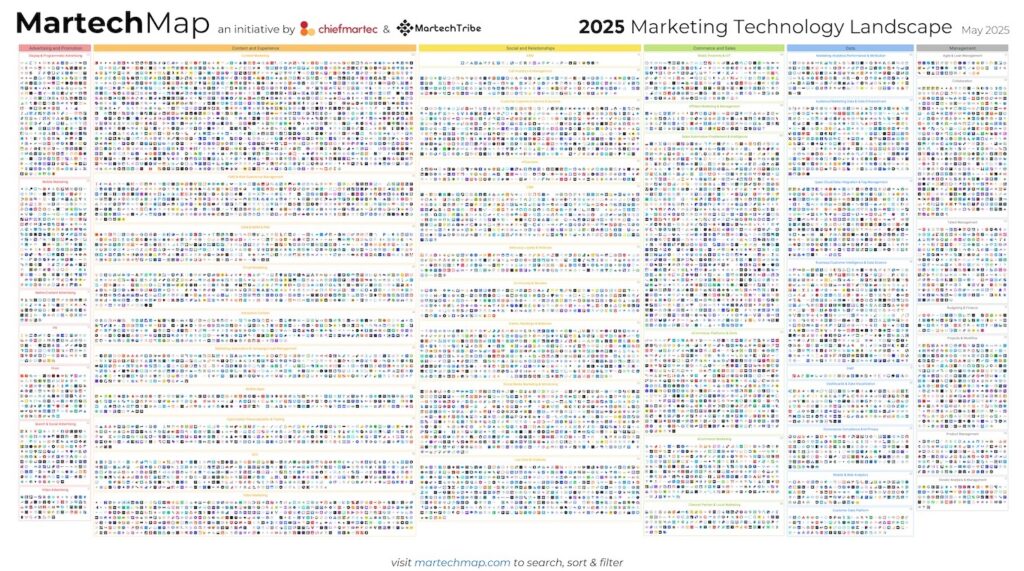
In contrast, the marketing automation space has no lack of serious players — Eloqua, Aprimo, Alterian, Unica, Marketo, Pardot, etc. — as well as related firms, such as Hubspot and my own company, ion interactive, which specializes in landing page management and optimization (more broadly, post-click marketing). Yet if you were to take all of the customers of all of these companies combined together, they’d be measured in the thousands, not the tens of thousands.
Why is there an order of magnitude adoption gap between marketing and even just one, albeit very successful, sales software company?
A few theories to contrast marketing and sales software:
- Salespeople have been using software for a couple of decades now to track their contacts. Not to say that Salesforce.com wasn’t brilliant with their SaaS implementation — they did an incredible job — but programs like Act! and Goldmine had laid the groundwork years before. Getting salespeople to adopt Salesforce.com didn’t require them to convince people of an entirely new category of software for their businesses. In contrast, much of the software being offered to marketers is entirely new — most marketers have never used marketing automation or landing page optimization.
- There’s a reasonable amount of homogeneity in the structure and tasks of sales. Not to say that there aren’t differences from one company to the next, or one salesperson to the next, but I’d venture to say that there are far more similarities than differences. In contrast, marketing is a more diversified discipline, with more specialist roles. Consider that under the label “marketing” you have public relations people, brand managers, creative directors, database marketers, graphic designers, event managers, copywriters — the whole strange and wonderful split between marketing agencies and marketing departments — and that’s not even considering the new roles that the web has birthed (see next point). There’s a lot variation in how companies run marketing too, where the motivation to be creatively different than the competition is deeply rooted in marketing’s worldview. It makes the goal of “one software to rule them all” much more complicated.
- Every aspect of business has been changed by the Internet, but some more than others. Sales has been impacted by the web, to be sure, but for the most part sales today is a lot like sales was 10 or 20 years ago. Its skill set, tactical toolbox, and strategic thinking are largely the same. In contrast, marketing is in the middle of a complete whirlwind of creative destruction — as things like print advertising, direct mail, and trade shows are fading and whole new channels and vehicles of search marketing, social media marketing, post-click marketing, mobile marketing, and email marketing are emerging. Marketers are overwhelmed by the speed and scope of these changes, which makes it more difficult to define and adopt any one specific solution.
- When it comes to sales force automation and CRMs, you pretty much know who the competition is: Salesforce.com, Siebel/Oracle, SugarCRM. In contrast, because marketing software is such a new space, and one that is very much in flux, the competitive lines aren’t as clear. For instance, while ion maybe has two or three direct competitors in landing page management, there are probably two dozen companies that overlap in partial ways, from PPC campaign management to website optimization to behavioral targeting. All of these companies are trying to define the market according to their worldview, competing as much on memes and nomenclature as they are actual product features. Unfortunately, this noisy battle over framing the market(s) often becomes a cacophony for marketers who are trying to sort out exactly what they need. To a certain degree this is an embarrassment of riches — marketers have a wealth of choices at their feet. But choices can be hard to make.
There’s certainly a lot of good news in this prognosis. The opportunity for marketing software is wide open. It’s a safe assumption that eventually marketers will widely adopt software for their entire range of strategic and tactical missions. My opinion is that there will be many different winners in different categories, with interoperability driven by web services and semantic data. Other people predict a more consolidated outcome, akin to Salesforce.com.
The upside of having no dominant reference model yet is that innovators and entrepreneurs can give their imagination full reign. Because many of the problems being solved are entirely new problems, they’re ripe for creative and original solutions.
The downside is that sorting this all out is still a challenge for marketers and vendors alike. But what a spectacular challenge to tackle.
Hi Scott
I think this needs to be linked to a transformation in the nature of marketing, which is becoming more accountable, participating in open networks and converned with how value is created and communicated. I suspect the emergence of one or several reference models (and like you I expect there will be several) will be dependent on the emergence of a new understanding of how marketing adds value. There is also a broken link between marketing and sales. Creating more effective feedback between marketing and sales is another important catalyst, especially in the B2B space.
Hi, Steven — that’s a great point.
There’s a fascinating “virtuous cycle” between an ever more trackable digital world, the drive for greater accountability in marketing, and the potential for software to feed (and be fed by) both. I heartily agree with you that this will have a tremendous impact on the winning “reference models” — and that we’re all still very early in that evolution.
However, not all transformations have the same patterns. One thing I wonder about with this transformation in marketing is how much of it is “additive” — adding new dimensions, channels, and vehicles to marketing, without removing an equal quantity of the old ones. This was the kind of the underlying point of my post on branding the other day. Social media doesn’t invalidate traditional branding; but they have big interdependencies that didn’t exist 10 years ago.
With all the new things marketing must engage in, is it converging or diverging? Probably both, depending on which lens you look at it through.
Of course, as we’ve discussed, there are definitely innovations working in marketing’s favor for all of this. The potential for open, linked data — in the enterprise for sure, but hopefully beyond in the ever-imminent semantic web — can make the coordination and relationship management of many different marketing programs significantly easier. Integration is still a bit of a hurdle these days, and the lowering of those barriers will do wonders for the entire industry.
Your point about fixing the link between marketing and sales is right on too. For all the distinctions we make in the tasks and talents of marketing and sales, in the eyes of the customer, it’s pretty much one continuous experience. If it’s not holistically excellent, then it’s a FAIL in their eyes — regardless of which link in the chain dropped the ball. Software can help a lot with this challenge, but it’s a cultural and strategic issue as much as a technical one.
Great article!
I think it’s also important to point out the fundamental cultural difference between sales and marketing. Sales people like accountability because their compensation is directly tied to results (which are relatively easy to measure in sales). They’re also very focused because every minute not spent selling is a minute lost. A lean, focused tool like Salesforce.com is obviously very attractive when you live in that culture.
Results in marketing on the other hand are inherently much more indirect and much harder to measure. The resulting culture is certainly more open and creative, but it is also infested by bogus, untested (and untestable) concepts and empty buzzwords. Accountability is a real threat to many people who make their living somewhere along the marketing value chain.
So I think some of the slow adoption of marketing software is due to a massive cultural shift and significant resistance from people who are afraid of accountability. In my experience (from almost 15 years of online marketing and related activities), most of the resistance comes from middle management in corporate marketing departments, as well as from outside agencies.
Thanks, Andreas!
That’s a great observation, and one that I can’t believe I missed in my post: the accountability and transparency that software brings to these processes is a cultural threat to certain domains of marketing in a way that it never was for sales. Exactly as you point out: sales was already on the hook for the numbers.
I have to confess, I still do think there will be important parts of marketing that will defy precise quantification. And in the rush to champion method and measurement through the industry, I hope we don’t go too far — as I fear some digital marketing advocates do — into throwing out everything that can’t be calculated with 99.9% accuracy. I think the current debate around conversion attribution these days is a great example of something that’s important to observe and test and analyze, while still accepting the inherently probabilistic nature of the task.
But I digress!
In the big scheme of things, I think you’ve nailed the key issue: the big cultural upset of accountability in the marketing world. Unfortunately for those who would prefer the veil of marketing mystery and mystique — but fortunately for those of us pursuing marketing software — the accountability train has left the station, and it’s not turning back.
Scott,
great post, and it inspired some very interesting discussions. It’s interesting though, that throughout, there is an assumption that “sales” and “marketing” are defined domains that will continue to exist, even if everything within them undergoes a full cycle of creative destruction.
Personally, I think that is a challengable assumption. Much as Zappos and others have shown in the realm of social media, quality of support can have as much of an effect on brand in today’s world as any TV spot ever could. Does support evolve to be a critical part of marketing? Perhaps.
Similarly, in the artificial gap between sales and marketing, as the two groups get closer, do they not look at merging many of their functions? Marketing is developing an awareness, a process, and an information flow to guide a potential buyer from awareness, right through to purchase and advocacy. Sales provides the human element, the intuition, and the political savvy to know when/how to guide the people involved.
Currently, we tend to think of Marketing *then* Sales in a linear A then B process. However, buyers don’t buy like that, and in the maelstrom of marketing’s fundamental transformation, there may be an opportunity to redefine where we draw the box around what we call “marketing” in the future.
Great post – thought provoking, thanks!
Hi, Steve — delighted to hear that this sparked interesting discussions (every blogger’s dream).
It’s funny that you comment on the divide between marketing and sales. As I was writing this, I had a voice in the back of my head recalling the passage from your book about the “vanishing sales rep.” Marketing does go much deeper into the sales funnel these days than ever before — and in the case of e-commerce sites such as Zappos, it goes so far as to encompass the entire sales process and beyond.
I think you’re right, that moving forward, there will likely be more of a blurring between marketing and sales, and that previously linear processes will give way to a more interwoven, multi-touch model of customer relationship management. I was recently reading some of the same ideas in so-called “social CRM” systems that are converging on that notion from another angle.
However, while these new innovations are exciting — and have great promise for the future of marketing — they still face the challenge of existing organizational structures and incentives, in both marketing and sales. As Andreas pointed out, that’s probably a bigger hurdle than we’d like to admit. The success stories of early adopters helps provide momentum to overcome that inertia, but for the immediate future, it still seems like bicycling uphill.
Hi Scott,
Interesting article. We are certainly in the very early days of Marketing Automation adoption with only 2000 customers world wide from a potential market of 1m+ companies! Geoffrey Moore’s chasm is no where in sight yet! The early adopters appear to be B2B marketers who are more comfortable around technology – no surprise that high tech firms are a strong contingent in the early adopters. I suspect the reluctance of some B2B marketing management to move faster is not one of wanting to avoid accountability, but simply a left brain – right brain challenge. In the past 30 years many of the successful B2B marketing management have been strong on the creative side – very right brain driven. Marketing Automation as it is currently being deployed, appeals to the more analytical left brainers. So will the technology change to attract more creatives, or will the make up of marketing change to recruit more analytical marketing operations people? Or both?
-Kevin