
At the most abstract level, your organization is a single entity. At the most detailed level, each of your customers is an individual, unique and special.
Perhaps the greatest challenge in marketing is reconciling these two forces: the unity of your brand and the individuality of your audience.
You want to speak to people as specifically as you can, addressing their particular wants and needs, related in a way that resonates best with their perspective of the world. But businesses grow by also tapping into the commonalities of many customers, identifying segments that can be scaled in a non-linear fashion.
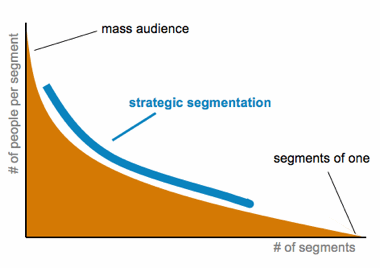
The disruptive innovation of online marketing is that it has enabled near limitless — at least in theory — parsing of your global audience into highly targeted segments, even micro-segments. This is The Long Tail. Still, there are trade offs in how much time, effort, and money is involved in sliding down the curve from mass marketing to micro-marketing.
Picking your place on that curve — somewhere between prehistoric mass marketing and the Platonic ideal of segments of one — is possibly the most important strategic choice in online marketing today.
This is market segmentation granularity as strategy.
Technology designed to scale digital interactions, such as post-click management software and social media management software, can shift your sweet spot further down the curve. But there’s still a wide swath of possibilities for how segmented you choose to make your marketing.
Have you consciously made that decision?

Could you tell us more about how you see the trade offs here?
There must be some kind of ideal path for solopreneurs vis-a-vis larger well funded names.
Shouldn’t solopreneurs concentrate on building viable relationships first before branding?
How does USP and Brand creation interplay?