
What is the role of a chief marketing technologist?
Short version: a chief marketing technologist (CMT) is the person responsible for leading an organization’s marketing technology.
A company may or may not be a “technology” business, but in today’s world it needs to deftly leverage technology in its marketing to:
- optimize its marketing strategy and tactics;
- interface with its audience through digital channels.
In a wired world, marketing must be technology-savvy for a business to compete.
This parallels another movement in the enterprise, which is to elevate “marketing” beyond a function isolated in a specific department — e.g., throw it over the wall to marketing and back again — into a broader organizational capability. Marketing needs to be about continual growth and innovation, and that marketing-driven mission needs to permeate all areas of the business. Think Apple. Starbucks. JetBlue.
Combined, the embrace of marketing technology and the transformation of marketing to a primary driver of competitive advantage is the essence of New Marketing — marketing without borders.
But what constitutes “marketing technology”?
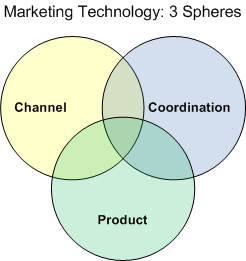
Part of the challenge is that the breadth of applications that now reside under the domain of marketing is incredibly diverse. I think of marketing technology as generally belonging to one of three spheres (or overlaps between them):
- A channel to the market.
- An internal coordinating device.
- An integral part of the product.
Marketing technology as a channel is using digital media — primarily Internet-based — to reach and engage with prospects and customers. Examples include:
- the web site;
- online advertising;
- search engine marketing;
- post-click marketing;
- behavioral targeting;
- social networking;
- online communities, forums, wikis;
- email marketing;
- syndicated content;
- mobile marketing;
- semantic marketing;
Marketing technology as a coordinating device is designed to organize and optimize the planning, execution, and analysis of everything marketing does — to process-ize it, measure it, improve it, and accelerate its clockspeed. Examples include:
- web analytics;
- business intelligence;
- customer relationship management;
- campaign management;
- competitive intelligence;
- sales force automation;
- digital asset management;
- content management;
- marketing/sales dashboards;
- marketing resource management;
- enterprise marketing management;
Marketing technology as a product is the embodiment of marketing principles into the product or service itself — such as e-commerce experiences in online stores. This is common in technology companies and pure Internet businesses, but increasingly firms in other spaces are offering complementary digital services as a competitive advantage as well.
These technologies may be based in several different operational areas:
- the marketing department;
- the IT department;
- the cloud: hosted applications and software-as-a-service;
- product operations (where applicable);
Wherever they operate, however, they are identified by being under the authority of marketing. The chief marketing technologist is responsible for the technical governance of this entire field of marketing technologies. This position must be headed by an equal blend of a marketing-savvy technologist and a technology-savvy marketer — a senior marketer-technologist leader. The main goals of this centralized, marketing-centric IT governance include:
- keep marketing technically competitive in all relevant application areas;
- facilitate useful interoperability and synergy between these applications;
- advocate for and adopt new technologies that drive growth and innovation;
- enable everyone else in marketing to leverage technology for their goals;
- navigate the lifecycle of marketing apps from one generation to the next;
- accelerate the overall clockspeed of marketing through technology and processization;
The chief marketing technologist works with the senior executive leadership at 2 or 3 key touchpoints:
- with the CMO to align marketing IT governance with marketing’s business objectives;
- with the CIO to align with IT’s infrastructure and broader technical governance requirements (e.g., security, business continuity);
- where applicable, with the product development team to incorporate and leverage marketing technology as a product and within products.
In companies where such roles exist, a chief strategy officer and/or a chief innovation officer may also participate in the marketing IT governance council.
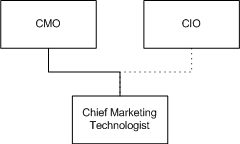
Although the chief marketing technologist needs to collaborate across the enterprise, the position needs to firmly sit under marketing. This role must serve the marketing agenda, and therefore it must be primarily accountable to the CMO. (The relationship of the CMT to the CMO seems analogous to the role of a CTO to a less technical CIO in IT-intensive organizations.)
Depending on the structure of the organization, it makes sense for this role to have dotted line or matrix reporting to the CIO.
However, I do not believe marketing technology should be led by the IT department. IT certainly has an essential role to play, taking responsibility for a company’s overall computing infrastructure — the network and server and platform underpinnings of much of what makes marketing technology possible. IT can also broker compatibility and synergy between marketing technology and operations technology. But the databases and applications that run marketing need to belong to marketing: authority and accountability must be linked.
In a small company, the CMT hat might be worn by someone with other responsibilities — a director of marketing, web marketing, or perhaps even a technically-astute CMO. But once an organization achieves any significant scale, the chief marketing technologist is a full-time role. (If it’s not, your company is probably losing competitive ground in the marketing dimension.) For larger firms, the CMT will head up an entire team of marketer-technologists.
Who’s leading marketing technology at your organization?

Great site! it gave me wonderful information on all the marketing strategies. I really amazed by your post it is very clear about all the tips ans tricks.
I trust that your post will helpful in many factors.
Right on!
I’d actually argue, that depending on the type of business you’re in, a CMT is a full time role no matter how small the company is.
I work for a small e-commerce company and can tell you first-hand that one of the secrets to success is simply being relevant to your customers. Think about that… How do you make a product catalog with 20,000 products relevant to a customer? What is “relevant” anyway? How does relevancy scale to comparison shopping engines, online banner advertising and paid search?
These are the questions that get the juices flowing in any technical marketer and scare the hell out of non-technical marketers.
Nice job, Scott.
Jim
Compelling job spec for a Chief MarTec! While I acknowledge the need to “get my own blog,” I hope you’ll pardon my extended response to your inspiring post!
I think this blog adds to the portfolio of necessary corporate services/functions that have evolved into “decision sciences,” a term that USC’s John Boudreau has used to describe the progression of roles like accounting, sales, and procurement, to the venerated roles of finance, marketing, and supply chain management, respectively. Whether by an organic or proactive process, we have seen myriad organizational functions once considered necessary, transactional or administrative services become critical, value-driving elements of business success.
Boudreau’s work focuses on the proactive elevation of HR to a “decision science,” arguing that it is through the building of a recognized, cross-firm, cross-industry business-focused and consistent discipline that the HR function will be able to lead with the same authority as today’s finance and marketing functions. But this is a major challenge for HR, as human capital metrics are typically much more elusive than the hard numbers we can more readily access in finance, supply chain management, and, of course, marketing.
Now, with ever more data, and more effective ways of organizing data into actionable frames, and ultimately with more science behind the practice of marketing, this organizational function has perhaps fully evolved as a “decision science.” The CMO is now more empowered. And I could even see current sitting CMOs being replaced by up-and-coming Chief MarTecs or VP’s of MarTec. Further, whereas HR and “purchasing agents” have had to be their own advocates for functional elevation, for marketing/martec, the change has happened organically, driven by the invisible hand that has emerged from the nexus of thought leadership, creativity, data, product development, innovation, and ultimately, results tied back to clear marketing actions.
Could the future top leadership of any firm look more like CEO, CHRO, CFO, CMO? I think so. With the rapid building and adoption of cloud computing/SaaS, internal IT becomes virtually irrelevant, sorry Chief Information Officer, hello Chief Innovation Officer. Nick Carr is right. The remaining “chiefs” can rather efficiently work out the right governance and balance of technology use.
Yes. Information technology is now the realm of the marketer.
Jim — you paint a vivid picture with the image of 20,000 products that need to be combinatorially matched with, well, upwards of the 1.2 billion people on the Internet. 20,000 x 1,200,000,000 = 24,000,000,000,000 — 24 trillion — possible combinations of just the most favorite product.
Start thinking of a portfolio for a wishlist or a shopping basket and, well, that’s the real googol of the Internet.
But you’re absolutely right. Although technology has created this “problem” of mind-boggling scale in personalized marketing, it also tempts us with the key to unlock the right combinations in a pragmatic way. This is Chris Anderson’s Long Tail, and it has been harnessed by the likes of Amazon, eBay, and Google.
We agree: it’s the mission of the chief marketing technologist to harness it for their companies without Jeff Bezos or Larry Page at the helm.
Thanks for the post!
Hi, Jeff — thanks for the thoughtful comment.
You know, it’s funny. If people proposed to implement a “behavioral tracking” algorithm as part of HR, something that would track every action that employees did online, apply various weights and business rules to it, and — plop! — out would pop the quarterly review with a salary recommendation, I think most people would jump out of their skin. “Yikes! How can you expect to accurately calculate my value based on my clicks and typing?!”
Meanwhile, a number of behavioral software packages in marketing propose to do just that to your customers.
Obviously, the context is different. And in many cases the stakes are much lower — although I’d say that for companies who have a potentially high LTV (lifetime value) of a customer, the stakes aren’t necessarily that much lower. Good people are hard to find both inside and outside. Of course, I’m a big advocate for leveraging technology for personalization. But it has to be done carefully and intelligently.
I love Carr’s writing, very provocative and inspiring. I’m not sure if I believe IT as a department is entirely going to go away. I suspect that leadership of a company’s overall computing infrastructure still has a lot of value. However, I absolutely agree that the application-level technology needs to be led by the teams responsible for those application domains. Marketing for marketing, operations for supply chain, and, yes, HR for HR. Love your vision of having those executives work together on overall technology governance. Is there a role for IT as the impartial mediator?
I haven’t met any impartial heads of IT, though I can certainly see future IT leaders requiring this impartiality. If future impartial CIOs are going to come from anywhere in IT, I would argue that the heads of networking and telecom (the most neutral of all IT functions) are the best candidates. Further, with the network being the most critical IT function in the future (with systems going outside, and moving to the control of marketing, operations, etc. as you’ve posited), it’s a natural evolution for VPs of network design and operations.
hi
could you help me identify a CMT in a telecom vendor perspective ..such as delivering services like cloud computing , also kind of eloborate on
1.predict the future of the marketing profession ithin the telecom service sector
2.how the skills, attitudes and behaviours of marketing
professionals will have to change in response to the emerging clod computing technology .. how marketers should prepare them self to cater the new technological breck through such like cloud computing
waiting for help on this
kind regards
Jumly
(jumly.sheriff@gmail.com)
Still a relevant and incredible article. Provides a lot of alignment to the Gartner Infographic. I think the only piece that I would call out, which you may have done in another post, is the need for this person to have a very innovative and strategic mindset.
I saw the innovative, but in my humble opinion, innovative and strategic need to go hand-in-hand.
Part of the CMT’s role should be driving the strategic direction of all you mentioned – and then some. (e.g. Data collection and governance.)
Incredible article.
I’m now going to spend a couple of days trying to skim through the rest of yours.
Thanks — I’m glad to hear it resonated with your experience!